
Drupal 8で設定エンティティタイプを作成する
このページでは、Drupal 8用に管理ページを備えた設定エンティティタイプを作成する方法の例を示します。シンプル設定と設定エンティティの概念については、https://drupal.org/node/2120523を参照してください。
以下のコードを含むサンプルモジュールを有効にすると、設定フォームの例がスクリーンショットに示すように「admin/config/system/example」で利用できるようになります:
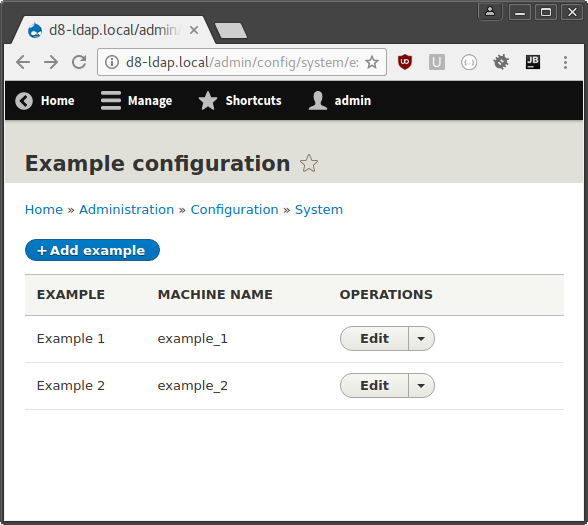
モジュールと管理者メニューエントリの設定
example/example.info.yml
name: Example
description: 'Manages example configuration.'
package: Example

type: module
core: 8.x
ルーティング
(エンティティパスの処理に追加されたヘルパークラスを参照して、これをどのように簡素化できるかを確認してください。)
example/example.routing.yml
routing.ymlファイルは、管理ページ(一覧、追加、編集、削除)のルートを定義します。
entity.example.collection:
  path: '/admin/config/system/example'
  defaults:
    _entity_list: 'example'
    _title: 'Example configuration'
  requirements:
    _permission: 'administer site configuration'

entity.example.add_form:
  path: '/admin/config/system/example/add'
  defaults:
    _entity_form: 'example.add'
    _title: 'Add example'
  requirements:
    _permission: 'administer site configuration'

entity.example.edit_form:
  path: '/admin/config/system/example/{example}'
  defaults:
    _entity_form: 'example.edit'
    _title: 'Edit example'
  requirements:
    _permission: 'administer site configuration'

entity.example.delete_form:
  path: '/admin/config/system/example/{example}/delete'
  defaults:
    _entity_form: 'example.delete'
    _title: 'Delete example'
  requirements:
    _permission: 'administer site configuration'
example/example.links.menu.yml
これにより、設定ページ -> システムへのリンクが追加されます
entity.example.collection:
  title: 'Example'
  parent: system.admin_config_system
  description: 'Configure example'
  route_name: entity.example.collection
example/example.links.action.yml
これにより、一覧ページに「追加」リンクが表示されます。
entity.example.add_form:
  route_name: 'entity.example.add_form'
  title: 'Add example'
  appears_on:
    - entity.example.collection
エンティティタイプのクラス
example/src/ExampleInterface.php
設定エンティティにプロパティがある場合、インターフェースでset/getメソッドをいくつか定義する必要があります。
namespace Drupal\example;

use Drupal\Core\Config\Entity\ConfigEntityInterface;

/**
 * Provides an interface defining an Example entity.
 */
interface ExampleInterface extends ConfigEntityInterface {
  // Add get/set methods for your configuration properties here.
}
example/src/Entity/Example.php
このファイルは設定エンティティクラスを定義します。
namespace Drupal\example\Entity;

use Drupal\Core\Config\Entity\ConfigEntityBase;
use Drupal\example\ExampleInterface;

/**
 * Defines the Example entity.
 *
 * @ConfigEntityType(
 *   id = "example",
 *   label = @Translation("Example"),
 *   handlers = {
 *     "list_builder" = "Drupal\example\Controller\ExampleListBuilder",
 *     "form" = {
 *       "add" = "Drupal\example\Form\ExampleForm",
 *       "edit" = "Drupal\example\Form\ExampleForm",
 *       "delete" = "Drupal\example\Form\ExampleDeleteForm",
 *     }
 *   },
 *   config_prefix = "example",
 *   admin_permission = "administer site configuration",
 *   entity_keys = {
 *     "id" = "id",
 *     "label" = "label",
 *   },
 *   config_export = {
 *     "id",
 *     "label"
 *   },
 *   links = {
 *     "edit-form" = "/admin/config/system/example/{example}",
 *     "delete-form" = "/admin/config/system/example/{example}/delete",
 *   }
 * )
 */
class Example extends ConfigEntityBase implements ExampleInterface {

  /**
   * The Example ID.
   *
   * @var string
   */
  public $id;

  /**
   * The Example label.
   *
   * @var string
   */
  public $label;

  // Your specific configuration property get/set methods go here,
  // implementing the interface.
}
admin_permissionキーは、その権限を持つすべてのユーザーに自動的にアクセスを許可します。より多くのロジックが必要な場合は、カスタムアクセスコントローラーを指定できます。
Drupal 8.6.x以降、すべての設定エンティティタイプはアノテーションにconfig_exportプロパティを持つことが推奨されます(config_exportを参照:https://www.drupal.org/node/2949023)。
設定スキーマファイル
example/config/schema/example.schema.yml
example.example.*:
  type: config_entity
  label: 'Example config'
  mapping:
    id:
      type: string
      label: 'ID'
    label:
      type: label
      label: 'Label'
example.schema.ymlでは、\Drupal\example\Entity\Exampleで定義されたプロパティ/属性を追加します。
example.example.*は、クラスのプロパティ/属性を参照する設定変数です。エンティティに別の変数名を指定するには、「config_prefix」を追加できます。例:
@ConfigEntityType(
..
... config_prefix = "variable_name" ...
その後、次のように参照できます:
example.variable_name.*: ....設定スキーマの詳細については、設定スキーマ/メタデータを参照してください。
エンティティクラス
example/src/Form/ExampleForm.php
namespace Drupal\example\Form;

use Drupal\Core\Entity\EntityForm;
use Drupal\Core\Entity\EntityTypeManagerInterface;
use Drupal\Core\Form\FormStateInterface;
use Drupal\Core\Messenger\MessengerInterface;
use Symfony\Component\DependencyInjection\ContainerInterface;

/**
 * Form handler for the Example add and edit forms.
 */
class ExampleForm extends EntityForm {

  /**
   * Constructs an ExampleForm object.
   *
   * @param \Drupal\Core\Entity\EntityTypeManagerInterface $entityTypeManager
   *   The entityTypeManager.
   */
  public function __construct(EntityTypeManagerInterface $entityTypeManager) {
    $this->entityTypeManager = $entityTypeManager;
  }

  /**
   * {@inheritdoc}
   */
  public static function create(ContainerInterface $container) {
    return new static(
      $container->get('entity_type.manager')
    );
  }

  /**
   * {@inheritdoc}
   */
  public function form(array $form, FormStateInterface $form_state) {
    $form = parent::form($form, $form_state);

    $example = $this->entity;

    $form['label'] = [
      '#type' => 'textfield',
      '#title' => $this->t('Label'),
      '#maxlength' => 255,
      '#default_value' => $example->label(),
      '#description' => $this->t("Label for the Example."),
      '#required' => TRUE,
    ];
    $form['id'] = [
      '#type' => 'machine_name',
      '#default_value' => $example->id(),
      '#machine_name' => [
        'exists' => [$this, 'exist'],
      ],
      '#disabled' => !$example->isNew(),
    ];

    // You will need additional form elements for your custom properties.
    return $form;
  }

  /**
   * {@inheritdoc}
   */
  public function save(array $form, FormStateInterface $form_state) {
    $example = $this->entity;
    $status = $example->save();

    if ($status === SAVED_NEW) {
      $this->messenger()->addMessage($this->t('The %label Example created.', [
        '%label' => $example->label(),
      ]));
    }
    else {
      $this->messenger()->addMessage($this->t('The %label Example updated.', [
        '%label' => $example->label(),
      ]));
    }

    $form_state->setRedirect('entity.example.collection');
  }

  /**
   * Helper function to check whether an Example configuration entity exists.
   */
  public function exist($id) {
    $entity = $this->entityTypeManager->getStorage('example')->getQuery()
      ->condition('id', $id)
      ->execute();
    return (bool) $entity;
  }

}
example/src/Controller/ExampleListBuilder.php
namespace Drupal\example\Controller;

use Drupal\Core\Config\Entity\ConfigEntityListBuilder;
use Drupal\Core\Entity\EntityInterface;

/**
 * Provides a listing of Example.
 */
class ExampleListBuilder extends ConfigEntityListBuilder {

  /**
   * {@inheritdoc}
   */
  public function buildHeader() {
    $header['label'] = $this->t('Example');
    $header['id'] = $this->t('Machine name');
    return $header + parent::buildHeader();
  }

  /**
   * {@inheritdoc}
   */
  public function buildRow(EntityInterface $entity) {
    $row['label'] = $entity->label();
    $row['id'] = $entity->id();

    // You probably want a few more properties here...

    return $row + parent::buildRow($entity);
  }

}
example/src/Form/ExampleDeleteForm.php
namespace Drupal\example\Form;

use Drupal\Core\Entity\EntityConfirmFormBase;
use Drupal\Core\Url;
use Drupal\Core\Form\FormStateInterface;

/**
 * Builds the form to delete an Example.
 */

class ExampleDeleteForm extends EntityConfirmFormBase {

  /**
   * {@inheritdoc}
   */
  public function getQuestion() {
    return $this->t('Are you sure you want to delete %name?', array('%name' => $this->entity->label()));
  }

  /**
   * {@inheritdoc}
   */
  public function getCancelUrl() {
    return new Url('entity.example.collection');
  }

  /**
   * {@inheritdoc}
   */
  public function getConfirmText() {
    return $this->t('Delete');
  }

  /**
   * {@inheritdoc}
   */
  public function submitForm(array &$form, FormStateInterface $form_state) {
    $this->entity->delete();
    $this->messenger()->addMessage($this->t('Entity %label has been deleted.', array('%label' => $this->entity->label())));

    $form_state->setRedirectUrl($this->getCancelUrl());
  }
}